GRAMOPHONE review: Look How Brightly
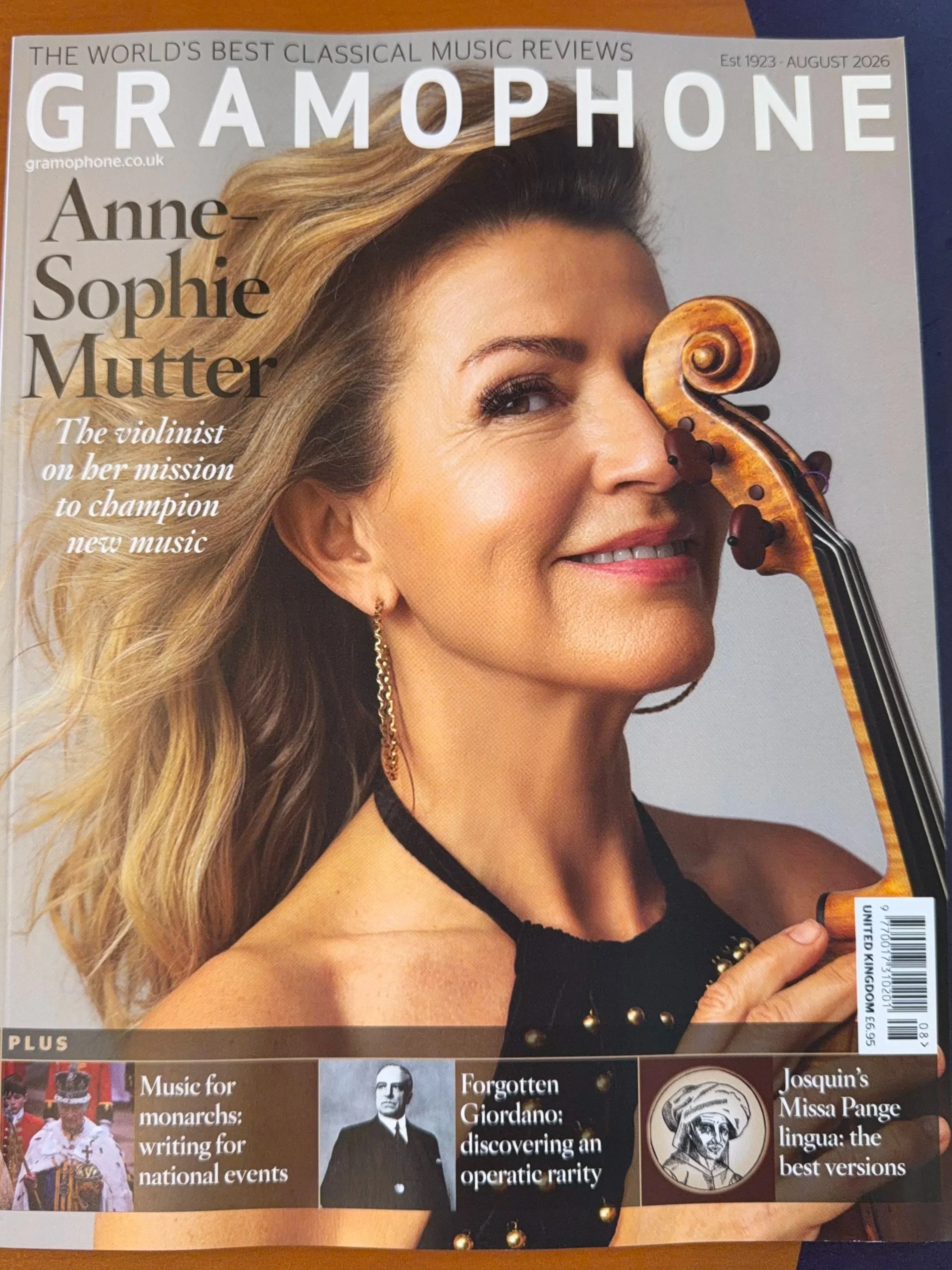
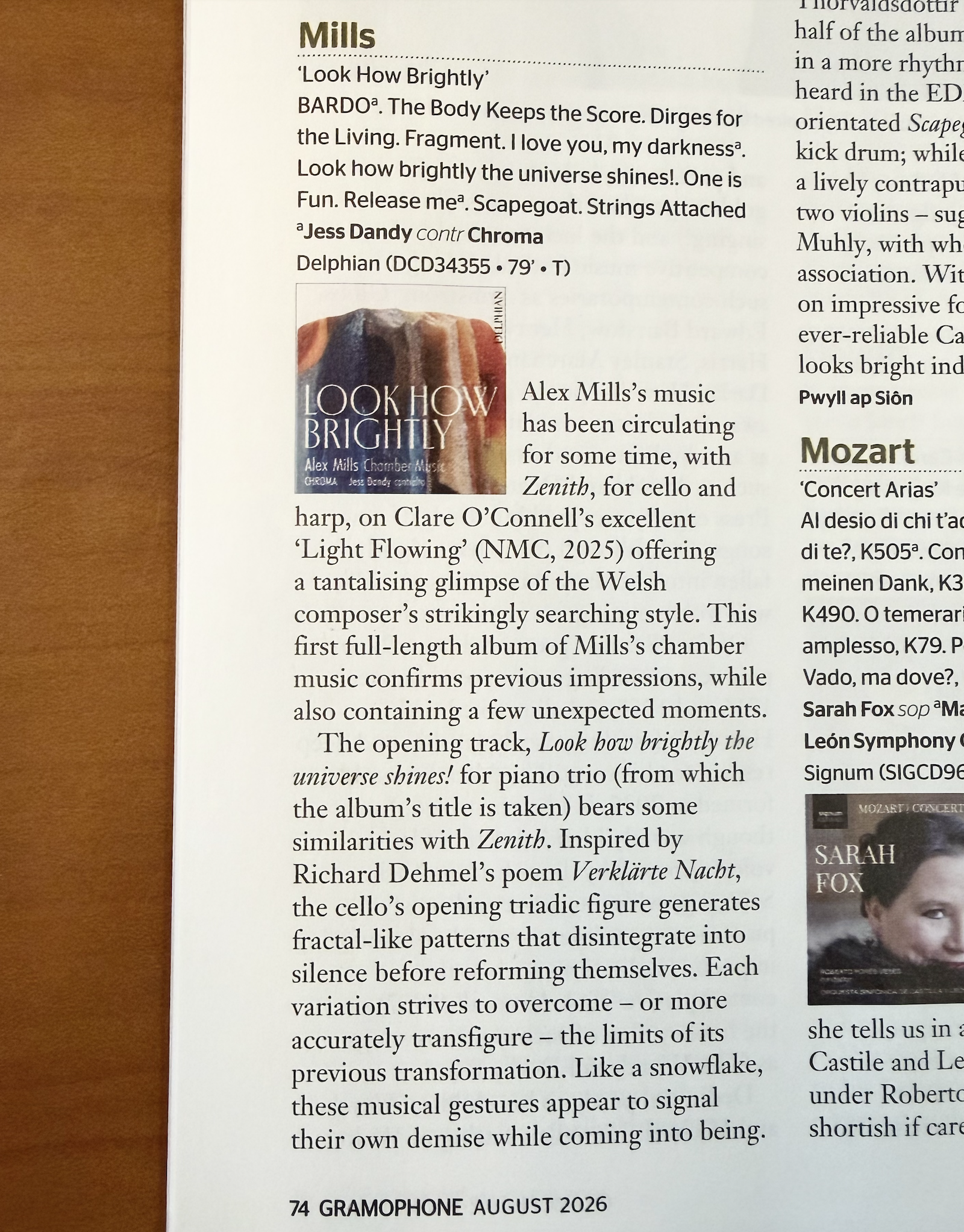
I was thrilled to discover a wonderful review of Look How Brightly in the August issue of Gramophone.
The review, by Pwyll ap Siôn, describes the album as confirming the “strikingly searching style” of my music, while also highlighting some of its more unexpected and rhythmically dynamic moments.
It’s particularly lovely to see the whole album discussed in such depth — from the opening piano trio Look how brightly the universe shines! and the stillness of BARDO, through to Scapegoat and One is Fun later in the record.
And the review ends with words I’m very happy to read:
“With the Chroma ensemble on impressive form throughout, led by the ever-reliable Caroline Balding, the future looks bright indeed for Mills.”
Seeing the album in the pages of Gramophone feels like a real milestone. I’m hugely grateful to everyone who helped bring this music to life.
——
Here is the review in full:
Alex Mills's music has been circulating for some time, with Zenith, for cello and harp, on Clare O'Connell's excellent 'Light Flowing' (NMC, 2025) offering a tantalising glimpse of the Welsh composer's strikingly searching style. This first full-length album of Mills's chamber music confirms previous impressions, while also containing a few unexpected moments.
The opening track, Look how brightly the universe sbines! for piano trio (from which the album's title is taken) bears some similarities with Zenith. Inspired by Richard Dehmel's poem Verklärte Nacht, the cello's opening triadic figure generates fractal-like patterns that disintegrate into silence before reforming themselves. Each variation strives to overcome - or more accurately transfigure - the limits of its previous transformation. Like a snowflake, these musical gestures appear to signal their own demise while coming into being.
Presence and absence present just one of several paradoxes in Mills's richly ambiguous musical language. Unity and separation lie at the heart of Strings Attached for violin and piano, where both instruments' lines combine, converge and splinter, creating a dynamic sense of ebb and flow, stasis and movement, permanence and transience. A similar approach underpins Fragment for string quartet and Dirges for the Living for violin and cello, whose opening unisons yield in the former a series of wailing, keening gestures and in the latter more pointillistic textures.
A further dimension is provided through the addition of a female voice in one of the album's highlights, the two-movement BARDO, which engages with another paradox: death and rebirth. Contralto Jess Dandy's floating melodic shapes and haunting timbres bind the piano quartet's fragile lines, with the music almost reduced to a standstill by the end.
While one may be reminded in Mills's sparsely inhabited and pared-down approach of composers ranging from Hans Abrahamsen and Jürg Frey to Anna Thorvaldsdottir and Arvo Pärt, the second half of the album reveals the composer in a more rhythmically dynamic light, as heard in the EDM-inspired, minimalist-orientated Scapegoat for string quartet and kick drum; while One is Fun - which weaves a lively contrapuntal conversation around two violins - suggests the influence of Nico Muhly, with whom Mills has forged a close association.
With the Chroma ensemble on impressive form throughout, led by the ever-reliable Caroline Balding, the future looks bright indeed for Mills.
- Pwyll ap Sion
Copyright: Gramophone magazine, 2026