Behind the music: “BARDO”
Part of a series exploring each piece on my debut album, Look How Brightly
I have been fascinated by spiritual traditions for as long as I can remember. A few years ago, I read an English translation of The Tibetan Book of the Dead (or Bardo Thodol, literally “Liberation Through Hearing During the Intermediate State”). What struck me most was the extraordinary detail with which it describes the passage of the soul between death and rebirth in Tibetan Buddhism. The text is not only philosophy or myth; it is a practical spiritual tool, written to guide both the dying and the living through transition.
This idea, that a text might function as a profound spiritual tool, spoke deeply to me. It links to how I often think about a musical score: not only a set of instructions, but a frame that can create space, ritual, and transformation for those who engage with it.
The intermediate state
When I began writing BARDO, I had no intention of depicting the Bardo Thodol directly. Instead, I focused on the concept of bardo itself, the intermediate state between life and death. Around the same time, I came across Tamuke, a traditional form of Japanese shakuhachi music that functions as a eulogy for the dead. “Tamuke” translates as “hands folded in prayer.” In practice, a player may sit before an altar, performing until the memory of the departed is felt to be present. One teaching describes how “time is not part of this world; one should naturally lose oneself in the process, and several hours will pass in an instant.”
Composer Tōru Takemitsu wrote that shakuhachi music embodies Ichion Jobutsu, meaning “with one sound, one becomes the Buddha.”
A single, fully realised tone, produced with complete breath and attention, can embody the entirety of spirituality.
This image of one sound and one breath became central to BARDO. Like the Bardo Thodol, Tamuke is a kind of spiritual tool, a structure through which to encounter what is most difficult, and I wanted to create my own response: not a pastiche, but a musical reflection with the same quiet, attentive ritual.
Form and materials
The piece opens with a long, drawn-out melody spread between the strings, while the contralto threads a simpler version through the texture. The piano plays a repeating cycle of chords derived from the same mode, stacked a fifth apart to create resonance and depth.
In the second section, the piano brings this material forward. After circling through delicate, held sonorities, we suddenly begin to hear the piano differently: as an elaborately decorated drone on D, seemingly improvising around fragments of the opening. This leads into a “breath chorale,” in which the voice and strings move according to the rhythm of their own breathing rather than by barlines. The pacing is set by breath itself, so the music becomes indeterminate, and intensely personal.
D functions as a tonal anchor throughout, a centre of gravity around which the other voices orbit. This focus creates the sense of stillness that runs through the work. Time stretches and contracts, yet never disappears.
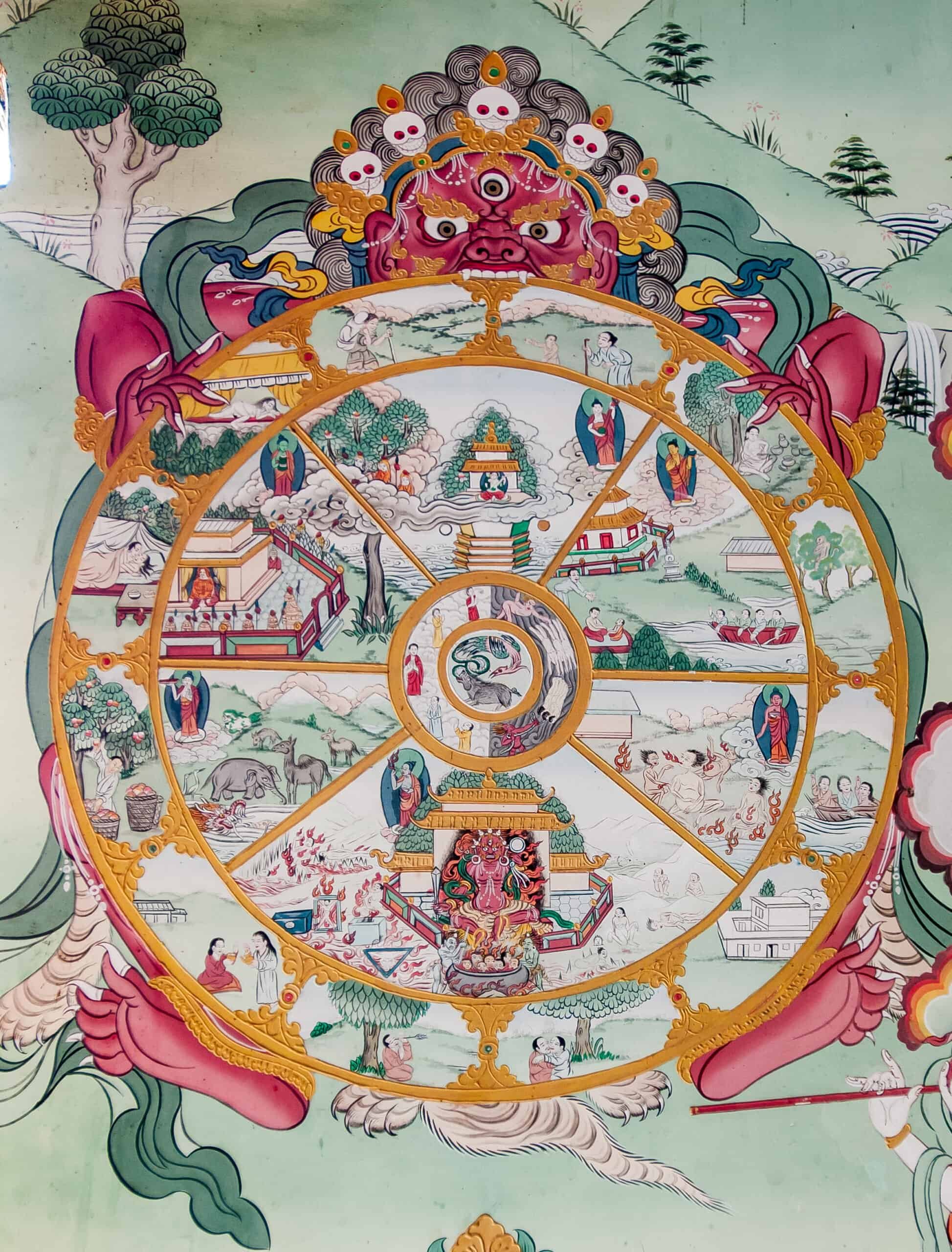
The Bhavachakra (Wheel of Life), a traditional Tibetan Buddhist painting depicting the six realms of existence within the endless cycle of birth, death, and rebirth.
Text and meaning
The text draws directly from Buddhist cosmology. In the first section, the contralto cycles through the Sanskrit names of the six realms of rebirth and existence: gods, demi-gods, humans, animals, hungry ghosts, and hells. Each represents a state of being into which one might be reborn, both literal and symbolic.The second section moves into a different dimension, using fragments from a Sanskrit chant related to the “hundred peaceful and wrathful deities” encountered as the soul travels between death and rebirth, as described in the Bardo Thodol. The text appears as isolated syllables, making it largely indiscernible, which reflects the unknowable length and nature of any “bardo” or intermediate state.
Breath and ritual
The breath chorale forms the centre of the piece. I have used this technique before, most expansively in Tuning Ritual for Orchestra, where the entire ensemble moves according to their breathing, but here, with a small group, it takes on a different intimacy. Time seems to stand still.
Anthropologist Roy Rappaport wrote that in ritual, everyday tempos are replaced by the rhythms of breath and pulse, creating “an extraordinary union of the quick and the changeless… implying eternity, and perhaps immortality.” This is how the breath chorale feels to me: a glimpse of something eternal through fragile, embodied sound.
Influence and resonance
Claude Vivier has been a touchstone for my music for many years, and his influence is strong here. As mentioned in my writing about Strings Attached, I am drawn to his focus on melody as a structural principle rather than the complex “structural frenzy” of some contemporary music. Sometimes a single line can generate a whole piece and carry more emotional weight than an elaborate system.
Other resonances were important too. Éliane Radigue’s Trilogie de la Mort, also inspired by the Bardo Thodol, unfolds as three hours of slowly shifting drones. Its austerity and patience remind me of the impersonal ritual Steve Reich describes in process music, where listening “makes possible that shift of attention away from ‘he’ and ‘she’ and ‘you’ and ‘me’ outwards towards ‘it’.” For me, the sparse materials of BARDO and its exploration of stasis offer both the musicians and audience space to turn attention away from the music, and the here and now, to something more profound.
Building on previous works
In many ways, BARDO connects back to an earlier work of mine, Saṃsāra, which I wrote for The Hermes Experiment in 2018. Saṃsāra means “endless wandering” in Sanskrit and is used in Buddhism, Hinduism, Sikhism, and Jainism to describe the cycle of birth, death, and rebirth that continues until enlightenment is reached. Much of it is without fixed pulse or time signature, which creates a fluid, wandering quality that mirrors the concept of endless cycles. In retrospect, Saṃsāra was an important step towards BARDO. Both explore transition, liminality, and the search for passage from one state into the next.
One sound, one breath
BARDO stands at the intersection of many threads in my work: unison and canon, single lines in counterpoint, breath-based pacing, and an ongoing interest in the role of ritual in music. It draws on spiritual practices, not to replicate them but to acknowledge their insight and to ask what a musical work can offer when it too becomes a tool for listening and transformation.