Behind the music: “Look How Brightly the Universe Shines!”
Part of a series exploring each piece on my debut album, Look How Brightly
I met composer Nico Muhly over ten years ago, just as I was beginning to venture seriously into composing. His unwavering support and encouragement over the years have been a huge part of me gaining confidence in my work, and I have learned so much from him, both as a friend and as a musician. One of the most important things he has shown me, and something that feels central to his unique approach to music-making, is the value of nurturing a close community of fellow artists with whom you love collaborating.
The cellist Clare O’Connell is part of that musical family for me. She was introduced to me by viola da gamba player Liam Byrne, who, in turn, was introduced to me by Nico. Clare is an extraordinary musician: she fully embodies the music she plays, and I love working with her for her generous, collaborative spirit and the deep respect she brings to performing new music. When she invited me to write a piece for her brilliant and imaginative concert series Behind the Mirror, I jumped at the chance. The commission was for a short piano trio inspired by Richard Dehmel’s 1896 poem Verklärte Nacht.
From meditation to fury
The piece I had written just before this one was quite experimental: a meditation for orchestra in which each player moved through the score at the rhythm of their own breath. The idea was simple, each performer had to let go of control and embody the sound directly through breathing rather than relying on technique. I imagined they would relish this freedom; instead, the reaction was one of discomfort and even resistance, and the experience left me feeling deflated and frustrated.
That frustration became the fuel for this trio. Where the orchestral piece had been sparse, meditative, and open, this new work would be rigorously notated, kinetic, and fast-paced, transforming my disappointment into defiance.
The power of unison
Unison has long been a fixation in my music, a theme that threads through several of my works including Strings Attached and One is Fun. The experience of playing or singing a single line together with others can be deeply unifying. It joins performers in breath, body, and intention. While polyphony and harmony bring their own beauty, there is a special emotional depth in the simplicity of one shared melody.
Alongside unison writing, I am also drawn to material that fractures and then reintegrates. To me, this reflects an inner wrestle we all carry, the ebb and flow between containment and unravelling.
This trio brings these ideas together: solo lines and unison passages drive forward before splintering into new textures and colours.
The music yearns to find coherence again, sometimes succeeding, sometimes collapsing into vivid, exuberant chaos.
Transfigured love
That same interplay between unity and separation connects directly to Dehmel’s Verklärte Nacht, the poem that inspired the piece. In it, a man and a woman walk through a moonlit forest as the woman confesses she is pregnant by another man. The air is thick with guilt and shame, yet the man responds not with anger but with compassion and acceptance. The night, and with it the emotional world of the poem, is transfigured.
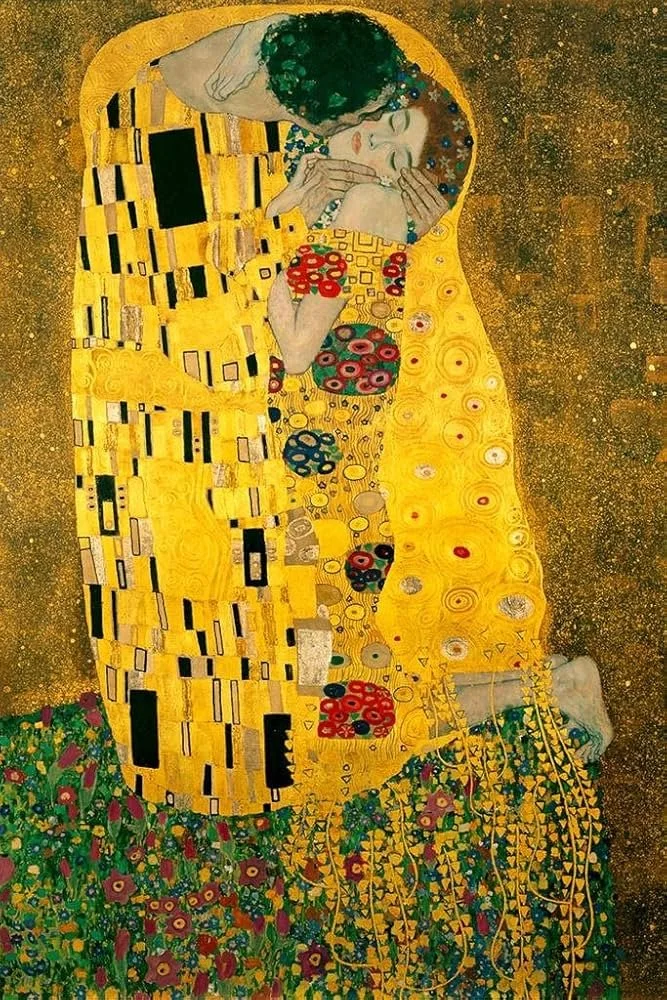
The line that gives this piece its title, “Look how brightly the universe shines!”, captures that transformation, the moment when compassion turns shame into serenity, which always reminds me of Gustav Klimt’s famous work, The Kiss (above). This same arc shapes the music. At times it is ominous and restless, at others radiant and glistening. Like the poem, it moves between conflict and acceptance, with unison passages giving way to moments of dissolution before finding reconciliation again. Although the gender dynamics of the text are uncomfortably dated, its emotional truth endures: a reminder of the redemptive power of love and the courage it takes to meet vulnerability with openness rather than judgement.
Community, vulnerability, and radiance
For me, this piece is also about community: my friendship with Nico, the generosity of Clare’s musicianship, and the chain of connections that led me to them both. It is about vulnerability, mine in recovering from a bruising orchestral project, and Clare’s in the way she embodies every piece she plays. And it is about transfiguration; the way music can turn frustration into energy, sadness into hope, and fear into acceptance.
'Transfigured Night' (Verklärte Nacht) by Richard Dehmel (1863 – 1920)
(English translation by Mary Whittall)
Two people are walking through a bare, cold wood;
the moon keeps pace with them and draws their gaze.
The moon moves along above tall oak trees,
there is no wisp of cloud to obscure the radiance
to which the black, jagged tips reach up.
A woman's voice speaks:
"I am carrying a child, and not by you.
I am walking here with you in a state of sin.
I have offended grievously against myself.
I despaired of happiness,
and yet I still felt a grievous longing
for life's fullness, for a mother's joys
and duties; and so I sinned,
and so I yielded, shuddering, my sex
to the embrace of a stranger,
and even thought myself blessed.
Now life has taken its revenge,
and I have met you, met you."
She walks on, stumbling.
She looks up; the moon keeps pace.
Her dark gaze drowns in light.
A man's voice speaks:
"Do not let the child you have conceived
be a burden on your soul.
Look, how brightly the universe shines!
Splendour falls on everything around,
you are voyaging with me on a cold sea,
but there is the glow of an inner warmth
from you in me, from me in you.
That warmth will transfigure the stranger's child,
and you bear it me, begot by me.
You have transfused me with splendour,
you have made a child of me."
He puts an arm about her strong hips.
Their breath embraces in the air.
Two people walk on through the high, bright night.