Behind the music: “Dirges for the Living”
Part of a series exploring each piece on my debut album, Look How Brightly
Dirges for the Living was my first premiere as a professional composer. It was performed in Paris in 2015 by Yvonne Lam (violin) and Nick Photinos (cello) from the American ensemble Eighth Blackbird. Understandably, I was extremely nervous. What I remember most now, though, is not the anxiety, but what this piece and its premiere taught me about the power of music and human connection.
The keening voice
The initial inspiration came from the Romanian bocet: a form of keening, a deeply emotional style of singing found in many cultures that expresses grief and sorrow for the dead. Often sung by a woman or a small group of women from the family or community, these laments repeat a refrain or melody with intuitive, improvised embellishments that allow grief to unfold in raw, spontaneous form.
What struck me in the field recordings I heard was how the music functioned as a practical way to process emotion. The repeated refrain offers structure, while freedom to improvise within it allows feelings to surface spontaneously, however jagged or unpredictable the result. This is music with a purpose: to face and release our deepest emotions rather than contain them.
Dirges for the Living does not attempt to recreate the bocet tradition. The intention and inspiration behind it, however — music as a ritualised space to grieve and to shape feelings too complex for words — became my starting point.
Mourning the living
The keening traditions that inspired me mourn those who have died. However, I began to think about other forms of grief we live with: loss, trauma, regret, the weight of what remains unresolved.
Could music provide a way not only to mourn the dead, but to give form to the grief we continue to face in daily life? That became the piece’s central question.
Three movements of grief
The first movement is closest in spirit to the laments that inspired the work. Its sighing phrases and narrow, yearning lines are heavy with darkness and the sound of deep grief.
The second dirge shifts the tone. Pizzicato textures and jagged rhythms bring frustration, anger, and resistance. Grief is rarely one-dimensional; it erupts, pushes back, and refuses to sit quietly.
The third dirge is different again, more open and forward-looking, though still tinged with melancholy. It holds the contradictions of grief: hope and sadness, reflection and renewal. If the first movement leans into grief, and the second fights it, the third carries it forward and begins to integrate it.
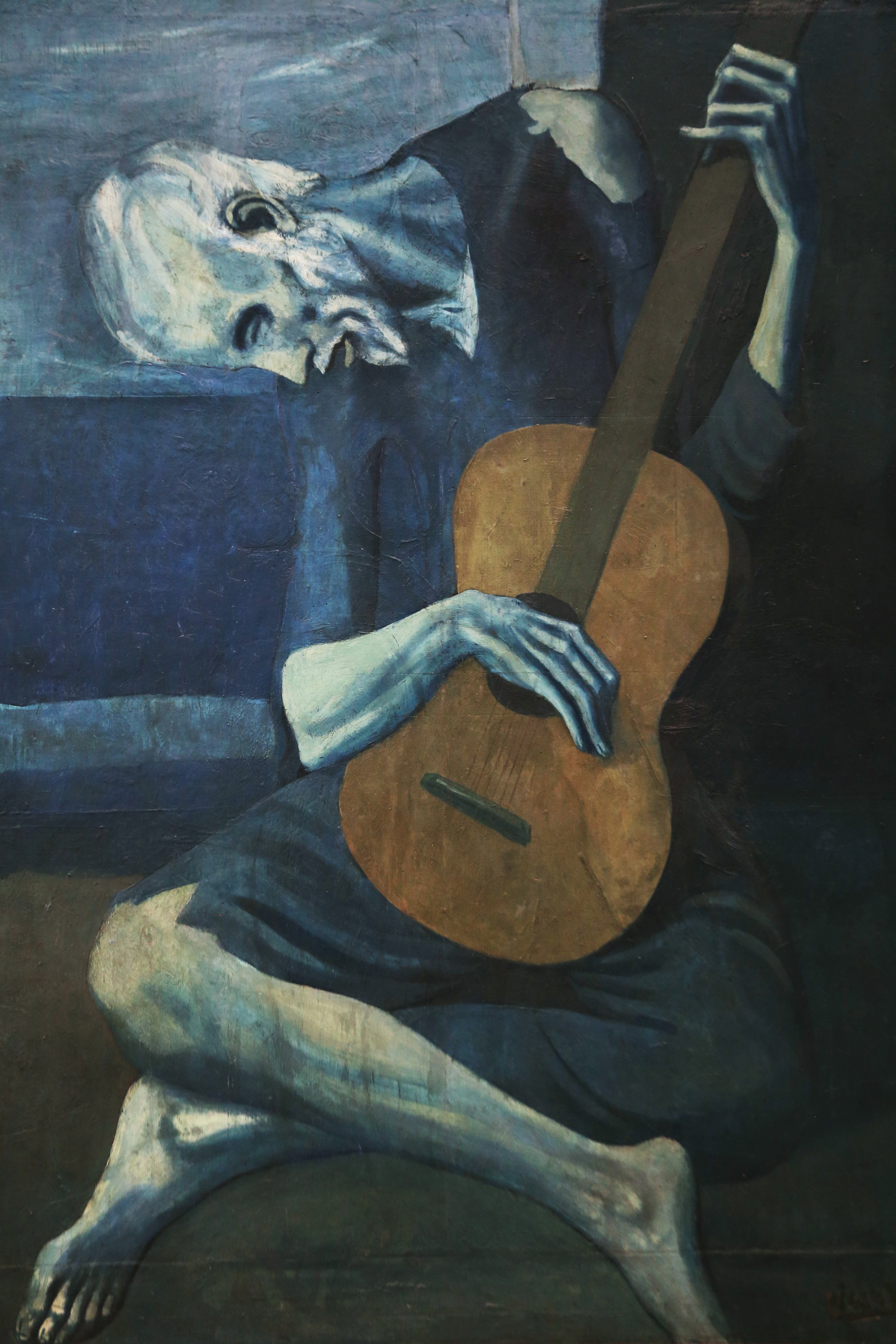
Pablo Picasso’s The Old Guitarist (1903)
Music as a mourning tool
The emotional world of Dirges for the Living finds a striking parallel in The Old Guitarist. Painted during Picasso’s Blue Period, the work depicts a solitary, emaciated figure bent over his instrument, absorbed in an act of quiet, necessary expression. The surrounding world feels drained of life, yet the guitar remains a source of fragile resonance — a means of giving shape to inner turmoil. This tension between desolation and expression mirrors the impulse behind the piece: music not as decoration, but as a vital process through which grief can be held, voiced, and transformed.
A gift from a stranger
At the premiere, imposter syndrome loomed. After the concert, a woman approached me and thanked me for the piece. Then she paused, deciding whether to say what she was thinking. Finally, she did: “A year ago, my husband tragically died in a road accident. Tonight, your music expressed the emotions I have been feeling ever since but that I have been unable to articulate myself.”
That brief exchange changed me forever — not only in my early career as a composer but in my life as a whole. She taught me, in a few seconds, that the music I write can touch the emotions of others, and she also taught me the power of vulnerability and connection. It was a transformative momentthat helped form the foundations of my self-belief as a composer. While imposter syndrome never fully disappears, whenever I doubt myself, I remember her incredible generosity and courage.
Heart speaks to heart
The encounter reminded me of the Latin phrase adopted by Cardinal John Henry Newman: cor ad cor loquitur — “heart speaks to heart.” The belief that truth can be found in intimacy and personal connection rather than in intellectual reflection. Newman was referring to prayerful encounters with God, yet the phrase resonates with how we glimpse truth in moments of shared vulnerability with one another.
Living with grief
Looking back, it feels right that my first professional premiere was a piece about how music can express our most complex emotions. So much of my work since has continued to explore that idea.
That is what Dirges for the Living is really about — not death and grief, but life, and what we still carry.