Why I launched my debut album as an art exhibition
I have a confession to make: I've never felt completely at home in the classical music world.
I didn't have an institutionalised music education. I studied fashion journalism. Before becoming a full-time composer, I worked in media and PR. Whether collaborating with the National Gallery and the V&A, or having work presented at Frieze New York, the projects that have excited me most throughout my career have tended to reach across disciplines — into dance, visual art, theatre and film.
So when my debut album, Look How Brightly, was finally ready for the world, the question of how to launch it felt like more than a logistical one. It felt like a statement of intent.
I started, dutifully, down the conventional route: planning a launch concert. I wrote to venues where I have a relationship, where my music has been performed before. Most didn't reply. Others referred me to their sales teams, who sent back corporate venue hire rate cards. Something wasn't quite clicking and while that was frustrating at first, it quickly became very liberating.
I stopped doing what I thought I should do, and turned my attention to what I actually wanted to do: to bring the album to life in a way that felt true to the music and to me.
The moment I turned toward the contemporary art world to explore an interdisciplinary launch, something shifted. Doors opened. People were curious. The question wasn't "why would you launch an album that way?" but "what could we make together?" Whether that reflects the art world itself or simply the people I was fortunate enough to meet, I'm not sure. But that openness to looking across art forms, to not knowing in advance what something will become, is something I found genuinely inspiring.
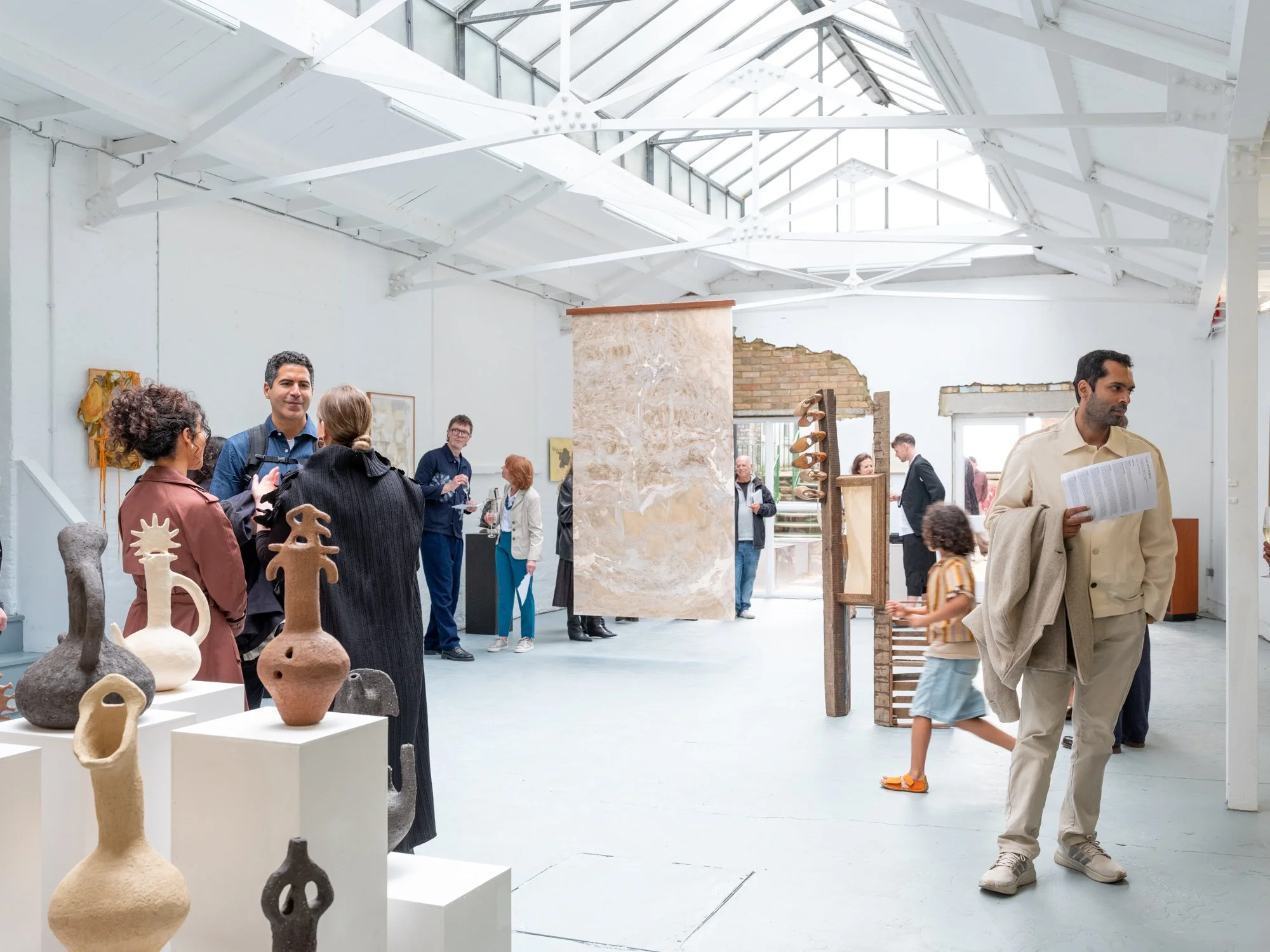
Look How Brightly is now an interdisciplinary exhibition at Pink Floyd's former recording studios in Islington, co-curated with my dear friend and serial collaborator, leading art curator Jenn Ellis, the founder of Apsara Studio. At its heart is a specially created sound installation: fragments of the album reimagined and reworked, heard through four large Tannoy speakers that occupy the space like sculptural objects. Around and within it are works by 21 international contemporary artists whose practices resonate with the themes of the album and my own compositional world: grief, embodiment, transformation, the passing of time, and the fragile balance between falling apart and coming back together. The artists don't illustrate the music. The music doesn't accompany the art. They exist in dialogue.
——> watch our video about the ‘making of’ the exhibition.
But there is a deeper reason I chose this format that goes beyond frustration with venues and rate cards. It has to do with what an album launch might become when we stop thinking of it as a single event.
The conventional launch — whether a concert, a press release, or a premiere performance — can often be a closed-off declaration. It presents a work as a finished statement, rather than the beginning of a conversation. I love what these tried and tested formats can do, but I wanted a more expansive way to present my work. The aim was never to replace the experience of listening. It was to create additional points of entry into it. Placing my music in conversation with other artists' visions, other languages and other emotional registers creates new ways for people to encounter it.
This made sense to me because increasingly people move fluidly between music, visual art, film and performance. My own creative life certainly doesn't happen in isolation either; it's shaped by influences that come from well beyond contemporary classical music, so it felt natural to create a launch that reflected that reality. I find myself less interested in "interdisciplinary practice" as a category than in the genuine encounters that become possible when different art forms are allowed to breathe next to one another.
What I've discovered, in co-curating Look How Brightly, is that an art exhibition offers possibilities for experiencing music that are difficult to achieve in a concert hall setting. There is no single direction to face, no pressure of collective attention, no defined moment of beginning and end. People wander, pause and return as they like, encountering the music in fragments, in peripheral awareness, in sudden foreground intensity. Through its proximity to visual art, new meanings can emerge and new questions can be raised. It's an open environment that welcomes people to engage on their own terms.
And while I love going to a dark room to sit in beautiful silence and hear a live concert, I don't want that to be my only interaction with music. I want more spaces where music can share the room with other art forms, inviting different kinds of attention, questions and conversations.
I may never feel entirely at home in the classical music world. But standing in the contemplative space that we’ve created, watching people move freely between sound, image and emotion and feeling moved, I'm not sure that's such a bad thing.
- Look How Brightly is open until 27 June at 35 Britannia Row, London, N1 8QH (Wed-Sat, 11am-5pm)